
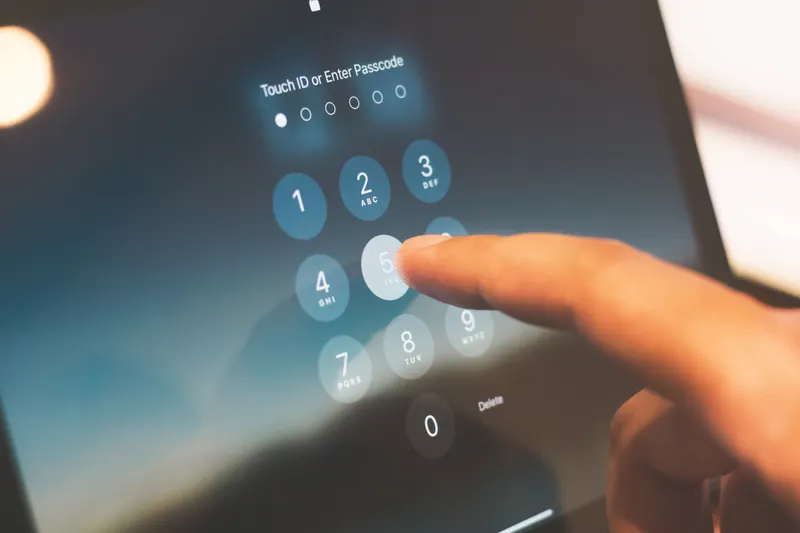
MFA has become essential
A password alone is no longer a sufficient control for exposed accounts: email, VPN, cloud consoles, SaaS administration, Git, CI/CD, financial tools and customer support.
MFA significantly reduces risk from reused, stolen or guessed passwords. But not all factors protect against the same attacks.
SMS codes, authenticator OTPs, push notifications and FIDO2 keys do not provide the same resistance.
Key takeaway. The right topic is not only “enable MFA”. It is to choose MFA that fits the account risk and the attack scenario.
The problem with copyable factors
OTP and SMS codes add a useful barrier. But they remain copyable.
A phishing site can ask for the password, then ask for the temporary code, then immediately use it on the real service. Proxy-based attacks can even relay authentication in real time.
Push notifications can also be abused through MFA fatigue: the user receives repeated prompts and eventually approves.
These methods are still better than no MFA, but they are not always enough for critical accounts.
What AI changes in phishing
AI does not make phishing magical, but it lowers the cost of credible scenarios. An attacker can generate better-written messages, adapt tone to a business role, translate a campaign, exploit leaked data or produce a more coherent phishing page.
In this context, copyable factors become more fragile. The more credible the message is, the more likely the user is to transmit a code, approve a prompt or follow a fake support process.
The answer is not to ask users to detect everything. It is to reduce what can be transmitted:
- favor phishing-resistant factors for critical accounts;
- limit long-lived sessions on exposed workstations;
- log enrollments and MFA method changes;
- design support procedures that never ask for a code or remote user approval.
Teaching point. AI mainly increases the credibility and speed of social attacks. FIDO2 helps because it removes the temporary secret the user could copy.
What FIDO2 changes
FIDO2 and WebAuthn rely on cryptographic authentication bound to the service domain. In practice, the key or passkey does not sign a request for a fake domain.
This strongly reduces phishing by code copying, because there is no temporary secret to retype.
Physical security keys such as YubiKey, Nitrokey or equivalent devices also address another issue: authentication depends on a controlled object, often protected by a user gesture and sometimes by a PIN.
Technical note. A FIDO2 key does not make an account invulnerable. It mainly reduces attacks where the user is tricked into transmitting a reusable or relayable factor.
A secret that moves
The temporary code can be sent to a fake site, then replayed immediately.
password + OTP
transmissible factor
account compromised
A proof bound to the domain
The key does not produce a valid signature for the fake domain being presented.
request rejected
real domain only
by domain
Where to start
There is no need to deploy keys everywhere on day one. The priority is to protect accounts that open the most doors.
Start with:
- cloud administrator accounts;
- email accounts for executives and finance roles;
- Microsoft 365, Google Workspace or equivalent administrators;
- Git, CI/CD and artifact registry accounts;
- VPN, bastion and secret manager access;
- support accounts able to impersonate or assist users.
Then expand progressively.
Operational points to prepare
A FIDO2 project is as much an operations topic as a security topic.
Plan for lost keys, initial enrollment, backup keys, recovery accounts, emergency procedures, temporary exceptions and user training.
The main risk is not the technology. It is the permanent workaround created because support processes were not prepared.
Conclusion
MFA should be treated as a risk policy, not a checkbox.
For critical accounts, phishing-resistant factors such as FIDO2 or passkeys provide a clear improvement over copyable codes.
A good rollout starts small, protects high-impact accounts, documents recovery procedures and gradually removes weak exceptions.